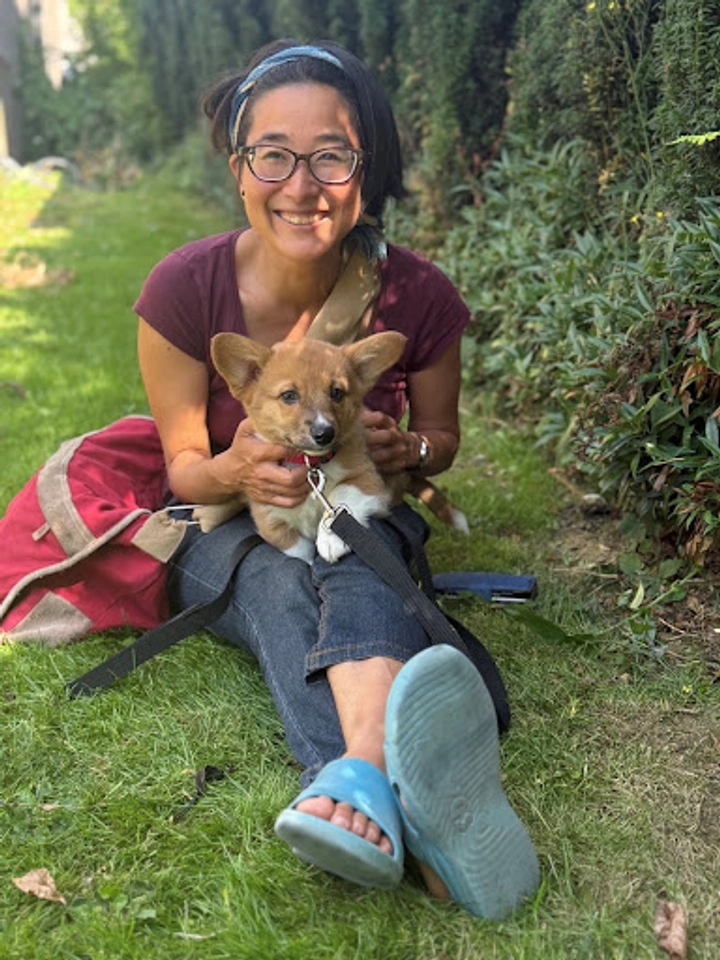
Maï Yasué - Keeping up with the Kermodes
Current Location: Vancouver
Entering Year: 2008
* Note on the following responses: Mai and I (Claire MacMurray) had the chance to chat over the phone recently. We talked about the questions below and this is my synthesis of what was shared (i.e. not all of these are verbatim Mai’s words but rather her overarching sentiments).
If you had had a Question while at Quest, what would it have been?
How do you create environments that support autonomous motivation? Some background on this question - I come from community-based conservation. In this world, it’s pretty evident that people/creatures have the motivation to create a context that supports the thriving of what you call self-transcendent values which are universalism, benevolence and self-direction, values that are about helping people beyond ourselves as well as personal growth, creativity, etc. Autonomous motivation, the motivation that likely underlies these self-transcendent values, is internal rather than taking the form of, “I need to make more money or I need to be better than that person”- these are extrinsic. People certainly have the ability to behave in a way that's in support of self-transcendent values. The idea is that we want more people to act in this way, but a lot of things prevent this from happening, right? That’s why this question is relevant. More autonomous motivation likely leads to us valuing the bigger (non-individual) causes. Check out these two links here for more background:
What does a day-in-the-life look like for you?
I run the equivalent of a DEI office for the faculty of medicine at UBC. My job either consists of educational capacity building (e.g. drafting tip sheets on how to apologize when you hurt someone else) and/or addressing conflict, conflict resolution, and supporting people coming back together. I look at how conflicts arise out of the structure/process (and what implementing educational reform looks like). I am personally motivated to bring self-transcendent values into the framework within the faculty of medicine and this definitely comes into play in conflict resolution. I like to think about relationality, how much relationships matter, how to create space for relational ways of being (and how this space aids conflict resolution); this might be the part of the job that I might enjoy most at this time. I love the people that I work with. There are a lot of emotions, a lot of pain and hurt when you are doing this type of work because you are working with a whole lot of people who have been traumatized by the system. But despite that, I do seem to spend a lot of time laughing at all the things that are nonsensical and absurd in the work that I do and how we have managed to find so much connection with each other through these difficult moments...
If you were to pick three things to devote most of your mental energy to, what would they be?
How to humanize others
How to create contexts where people think about humanizing others
I want to spend more time thinking deeply about things versus strictly responding to emails
I’d like to favor less reactive thoughts (i.e. slow down and think) especially when thinking about interpersonal conflicts
What was the most enriching conversation you had recently? Who was it with and what was it about?
One of the initiatives that our office runs is called the Indigenous Speaker Series. Most of the sessions are conversations between Derek Thompson a Nuuchahnulth hereditary chief & a lot of different Indigenous leaders. They 1) help us see a different model for leadership, one that is rooted in relationality, humility, authenticity, and 2) offer an Indigenous lens of historic/current events. We have also created opportunities for conversations amongst Indigenous families to come together and reconcile even within themselves. These conversations are super inspiring.
What is the most surprising element of your life and what is something that your life features that you could have predicted as a kid?
Surprising: the job that I have now is something that didn’t exist as a kid; never imagined working in a faculty of medicine
Not surprising: even as a kid, I’ve always been interested in social justice issues
Any ongoing projects/activities that uplift your soul? Or what seems to uplift your soul these days?
Going to the climbing gym with I-Chant and talking about life, our careers, and everything that inspires us: friendships, of course, helping each other figure out life
Working with so many different Indigenous staff and faculty has been really inspiring. Many of them are that generation who was the first to not go to residential schools, they are the ones who survived some of the trauma from their parents and are now doing all of this work to change colonial institutions and also work to heal themselves and their communities from the impacts of colonization.
In your life, who is the happiest person you know and what do you pick up on most in this person (that suggests they are happy)?
My daughter - she is very present-focused!
Pick three words to describe your Quest experience.
Intense, relational, meaningful
When you gather with friends, what is your favorite thing to do, as of late? With this question, feel free to share the quirky specifics, if they happen to exist.
Climbing, skiing, writing papers, eating good Asian food, indulging in all the time that my friends and I have (especially now that my daughter is older)
How do you decide what to eat for dinner or take for lunch? Walk us through your process.
Very random. I open the fridge. No planning involved - maybe I should plan more…😉
In your opinion, what is the food/meal with the greatest texture? Please explain your choice.
Hand-pulled Chinese noodles that Fei taught me how to make, also dumplings with wood ear mushrooms. I also really like the texture of stem lettuce and lotus.