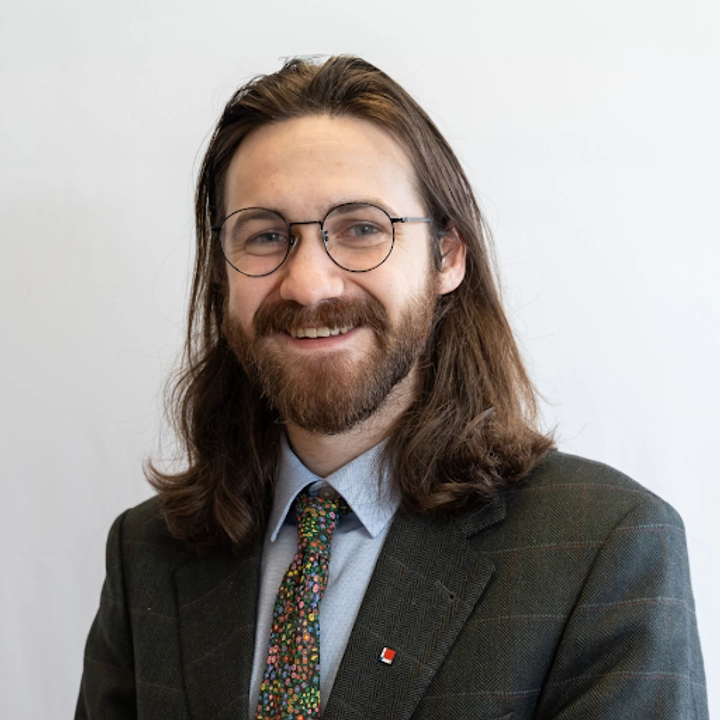
Jesse Genereux - Keeping up with the Kermodes
Current Location: Hamilton, Ontario
Entering Year: 2016
What was your Question?
My question was: “What is a good teacher?” I was interested in moral education (making better people, teacher of “the good”) as much as I was interested in the nature of the pedagogical relation.
What does a day-in-the-life look like for you?
A day in my life is hectic and honestly unbalanced. I am currently holding a full-time job as an Academic Quality Assurance Manager (recently finished an interim associate dean appointment) while pursuing a master’s degree in English and Cultural Studies at McMaster. The McMaster English department is a wonderful environment with a faculty and student body whose earnest interest in each other’s minds reminds me of the best parts of my Quest experience. As for a day-in-the-life, I wake up around 5 am and annotate readings on my tablet for my seminars on politics, literature and the Anthropocene. By 8 or 9, I am on campus reviewing my notes before engaging in seminar discussions. For work and between classes, I hop on Zoom to support the development of new degree programs for a private college in Toronto and a new university campus in Arizona. In the late afternoon and into the early evening, I teach two 1st-year undergraduate tutorials. I try to bring in the Quest spirit into these sessions, but they are only 50 minutes long and take place in traditional classroom-style setups, which limit the relationship and engagement possible. The hierarchy of the typical university experience is truly horrifying as a Quest alum. We were truly lucky to experience seminar-based instruction from day 1 through the 4th year. Throughout it all, I am downing 6-8 cups of coffee, either from home or from various sources of hot bean juice on campus. By 9pm, I am ready to leave campus and take the bus back to my graduate student residence. Before bed, I will do some studying, writing or catch up on the latest show on the Dropout streaming service. The best part of my day is getting to speak to Haby (Quest alum), with whom I continue to share my life.
If you were to pick three things to devote most of your mental energy to, what would they be?
I resonate with this question, as I’m sure many of you do, as our mental energies are commodities wrapped up in an exchange hard to visualize that rarely involves us. I’ll answer directly:
Wrapping my mind around the nature of ethical responsibility and its conditions. I would prefer to do so through poetry and philosophy. I feel this matter is pressing and if we can crack this nut, we might be able to help cultivate a more peaceful and just future.
Working on my own poetry. Poetry is quickly becoming a meditative practice that is helping me understand myself, my past, and my relations. Creative life is one that I have neglected and seldom made time for.
Actively connecting and reconnecting with friends. The pandemic and Quest’s ending fucked us up. There are so many of you I care about and think of regularly. I would like to reconnect and hear what you have been up to. I won’t make it to the reunion this year as I will be at a conference, so I’d like to spend more energy to deliberately reach out—not in a nostalgic manner, but to bear witness once again to the lives you live.
What was the most enriching conversation you had recently? Who was it with and what was it about?
Yesterday, I attended a talk by a prospective faculty member for a Canada Research Chair position in the department (Dr. Aguila-Way). As I eluded to, I am currently taking a course on the Anthropocene with my supervisor Dr. David Clark, along with another grad student and artist named Jay Pahre, who was in attendance. Dr Aguila-Way was presenting on her research regarding seed-saving as Indigenous epistemology-ontology. We had read some of the articles she cites (Vanessa Watts, for instance) in which the authors articulate a Haudenosaunee/Indigenous metaphysics which presents responsibility for non-human others originating from encounters with their agency. The kind of agency non-human others display is quite challenging to conceptualize, as is the nature of the responsibility arising from an encounter with such agency. For the Haudenosaunee people this is not difficult, but for settlers like me and Jay, it can be hard to process without reduction. I had a most enriching conversation with Jay about this. He had read an essay I had written grappling with this concept in which I had included images of the Squamish Estuary (included below).
/picture
Jay patiently sympathized with my difficulty and generously offered a critique of my photography as a means of hinting at disjunction between the internal organization of my subjectivity and the subject of Place-Thought and non-human agency (definitely reach out to me for more elaboration here). He said to question the horizons, the straight lines of my images. As you can see above, I have many straight lines in my photo, and the horizon of landscapes often dominates the frame. An alternative would decenter this structure and focus instead on a web of relations (gradients, closeups, more creative approaches). Jay’s insight has made me question the centrality of the moment of signification – the moment when one “thing” becomes “another” – and instead think of “things” as one andwith the other (and therefore, better encounter non-human agency). Quite the enriching conversation.
What is the most surprising element of your life and what is something that your life features that you could have predicted as a kid?
The most surprising element of my life was how naturally love came into it. There is chance to this, of course, and that is what I worried about a lot as a younger man. Before and during my Quest experience and even still today, I am a supremely anxious person. So, the fact that life brought me into the relationship I have and the very fact that I am not alone is really surprising to me. I think the stories that are told about love mischaracterize it. You do not fall into it. It isn’t a container into which one finds oneself with another, although there is some sense to it. If I were to keep the verb fall I might use the word “through”. The phrase “fall in love with” could be rephrased as “fall through love with”. This is what I mean by the word naturally. I didn’t know this and this revelation of love as something throughness is what surprised me. I found myself “in love” as it were, by being me with and for another. That being said, I could have predicted that I would be in academia. I didn’t expect to go farther than a bachelor’s, but I think I had a skewed understanding (as a kid) of what university was like. I didn’t grasp the progression. While I thought that I would have been done by now (I thought I would be a scientist by 30) the fact that I still am in academic environments and will be for the foreseeable future would not be surprising to little Jesse.
Any ongoing projects/activities that uplift your soul? Or what seems to uplift your soul these days?
I am producing a poetry chapbook (self-published booklet) with some colleagues in the McMaster English department that is shaping up to be very interesting. From illustrations to flash fiction and the traditional poetry that spans the space between, it is uplifting to bear witness to the meaning that others create. I also love going for walks, although the weather does not permit it these days. Something else I love is speaking to the other grad students in the department. All our offices are in the same hallway and sometimes we will stand in this hallway for an hour or so to just chat. Sharing a laugh with another is life-affirming in times like these.
In your life, who is the happiest person you know and what do you pick up on most in this person (that suggests they are happy)?
This is a very hard question. The first person who came to mind is a man named Oscar. I worked with Oscar as his support aide in High School. Oscar was diagnosed with autism spectrum disorder, described as “moderate-severe” (whatever that means), and found it difficult to relate to others at our school (Moscrop Secondary in Burnaby). Oscar loved to wrestle, play badminton, and grab your shoulder. Oscar, when I knew him, had the loudest and most genuine laugh you could imagine. He taught me how to laugh, I think. It was this manner of laughter that suggested to me that he was happy. He had his struggles, but they were more frustrations imposed by the world than an inner angst which characterizes most people’s lives.
Pick three words to describe your Quest experience.
Growth (keep sprouting)
Safety (intellectual, social)
Home (where I dwell)
When you gather with friends, what is your favorite thing to do, as of late? With this question, feel free to share the quirky specifics, if they happen to exist.
Jacob (Richardson), Charlotte, Gerhardt, AJ, Ty, and I have been playing a TTRPG online since the pandemic lockdown. All Quest students, I feel like this has been an anchor to a sense of continued community rooted in this shared experience. One of my favourite things that happens during these sessions is the memes and reactions to events occurring in the story posted to the OOC (out of character chat). Reaction gifs, jokes, and quips keep the overall experience light despite the narrative's often-heavy nature.
How do you decide what to eat for dinner or take for lunch? Walk us through your process.
If I eat lunch, it is whatever I can grab on campus. These days, more often it is a 5$ sandwich from the student union store that I add mustard, mayonnaise, pepper and some chips to. Sometimes it is a granola bar, some chili or random pastry to keep me going. If I am at home and have planned properly, I will have some Costco quinoa salad in a croissant with some rotisserie chicken and hot sauce. I did make some pea soup with homemade bone broth, but this was an anomaly. As much as I would like to make better food, it simply is not a priority for me when I live alone.
In your opinion, what is the food/meal with the greatest texture? Please explain your choice.
Pickled pearl onions have the best texture. Perfect balance of crunch and softness. I also feel like the acidity of the brine contributes to the experience of texture, adding a bit of sharpness to the crunch that I feel is very satisfying.